
This NCA-GENL study guide covers the NVIDIA-Certified Associate: Generative AI LLMs exam: what it tests, how the five domains are weighted, which NVIDIA tools you need to recognize, and a four week plan built on small notebook experiments. NCA-GENL is an associate level exam about how large language models work and how teams build, test and ship them. It is more about ML fundamentals than about any one cloud.
Quick answers
- Exam code: NCA-GENL.
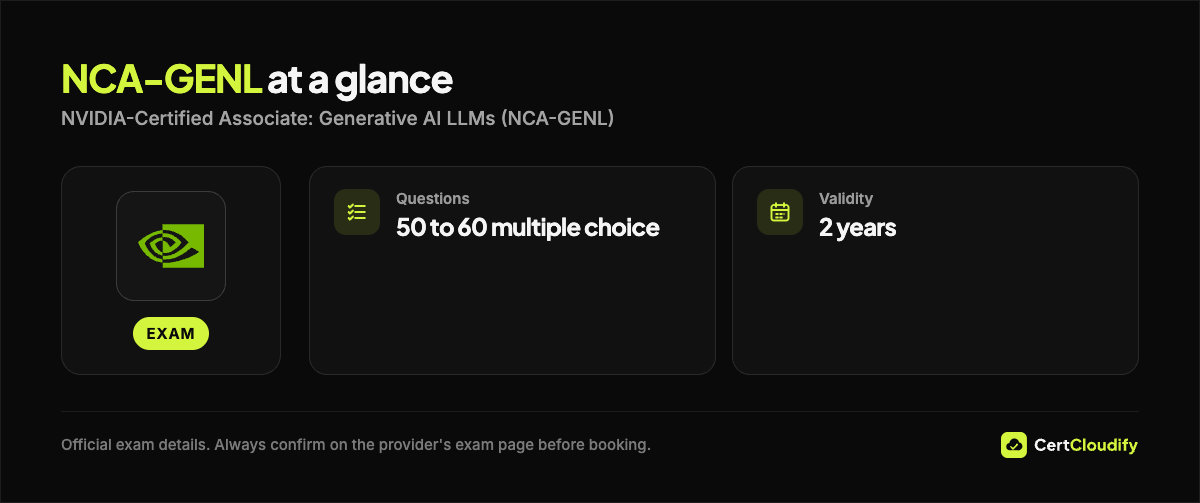
- Length: 60 minutes.
- Questions: 50 to 60 multiple choice.
- Delivery: online, remotely proctored.
- Validity: 2 years.
- Who it suits: developers, data scientists and ML engineers starting with LLMs, and anyone working with NVIDIA’s AI software stack.
NCA-GENL exam domains and weights
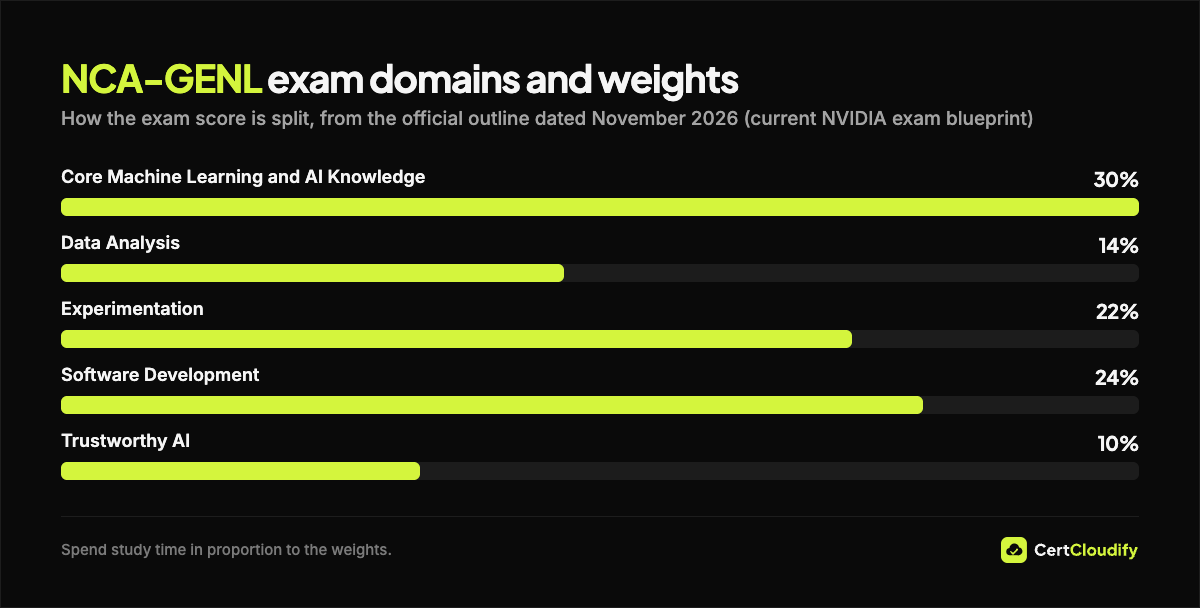
Based on the current NVIDIA exam blueprint (November 2026):
| Domain | Weight |
|---|---|
| Core Machine Learning and AI Knowledge | 30% |
| Data Analysis | 14% |
| Experimentation | 22% |
| Software Development | 24% |
| Trustworthy AI | 10% |
Core ML knowledge is the biggest domain, so do not skip the basics: how training works, what overfitting looks like, how transformers process text and what embeddings are. Experimentation and software development together are almost half the exam, which is why hands on practice in a notebook pays off.
What each domain really covers
Core Machine Learning and AI Knowledge (30%)
Transformers and self attention, encoder (BERT style) vs decoder (GPT style) models, tokenizers and subword pieces such as BPE, positional encoding, embeddings and cosine similarity, and the classic training problems. If training accuracy is high but validation accuracy is low, that is overfitting. If both are low, that is underfitting. If the loss explodes or turns into NaN, lower the learning rate or clip gradients.
Data Analysis (14%)
Preparing and analyzing data for LLM work, reading charts and choosing metrics. Know that RAPIDS cuDF gives you a GPU accelerated, pandas style API and cuML gives you GPU accelerated, scikit-learn style ML.
Experimentation (22%)
Fine-tuning with LoRA and other parameter efficient methods, prompt techniques (zero shot, few shot, chain of thought), evaluation metrics and A/B testing. Know which metric fits which task: perplexity for language model fit (lower is better), ROUGE for summaries, BLEU for translation, precision, recall and F1 for imbalanced classes, and recall at k for retrieval.
Software Development (24%)
Building LLM applications: retrieval augmented generation (chunk, embed, store in a vector database, retrieve, answer), serving models behind an OpenAI compatible endpoint, and the NVIDIA inference stack.
Trustworthy AI (10%)
Bias testing, safety, guardrails and alignment. Know that RLHF and DPO align models with human preferences, and that NeMo Guardrails adds programmable rails to LLM applications.
The NVIDIA tools you must recognize
Many questions ask which NVIDIA tool fits a task. Learn this table well:
| Tool | What it does |
|---|---|
| NeMo | Build, customize and train generative AI models |
| NeMo Curator | Clean, filter and deduplicate training data |
| NeMo Guardrails | Programmable rails for LLM apps |
| NIM | Prebuilt, optimized inference microservices |
| TensorRT-LLM | Optimize LLM inference on NVIDIA GPUs |
| Triton Inference Server | Serve models from many frameworks at scale |
| RAPIDS cuDF and cuML | GPU accelerated dataframes and ML |
| NCCL | Multi GPU collectives such as all reduce |
The four week NCA-GENL study plan
Run small experiments in a notebook every day: tokenize text, embed it, prompt a model and measure the results. Doing it once yourself makes the exam questions much easier to reason about.
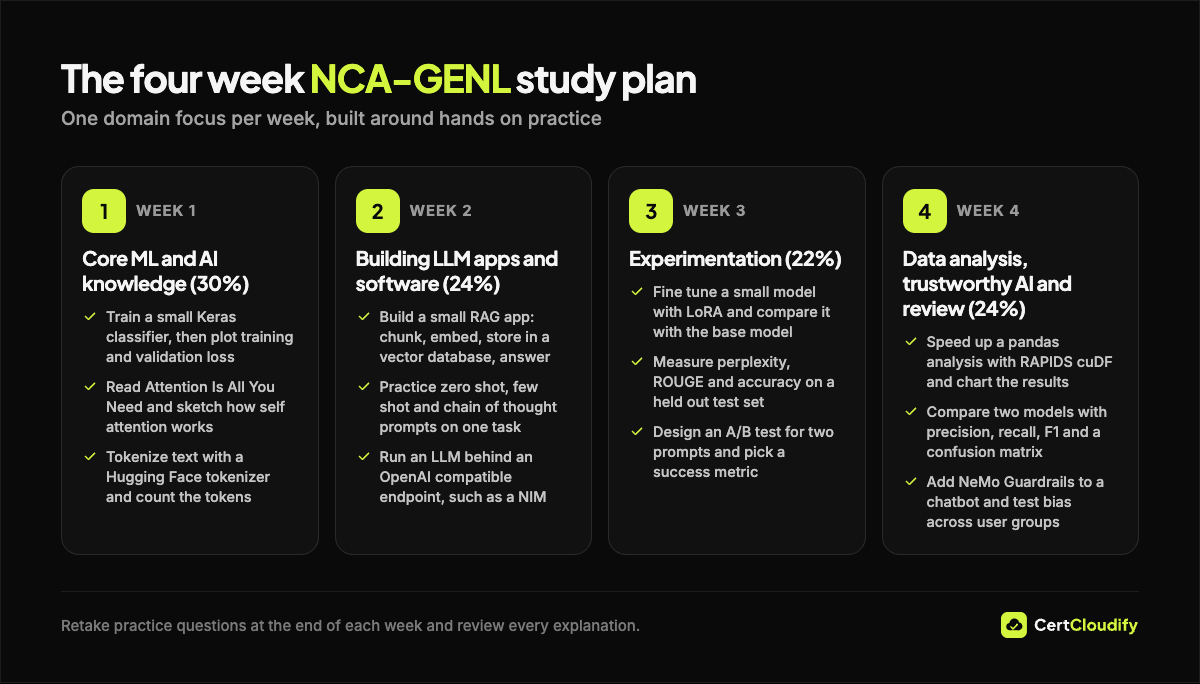
Week 1: Core ML and AI knowledge (30%)
- Train a small Keras classifier, then plot training and validation loss.
- Read the paper Attention Is All You Need and sketch how self attention works.
- Tokenize text with a Hugging Face tokenizer and count the tokens.
- Embed a few sentences, then rank them by cosine similarity with NumPy.
Week 2: Building LLM apps and software (24%)
- Build a small RAG app: chunk, embed, store in a vector database, answer.
- Practice zero shot, few shot and chain of thought prompts on the same task.
- Run an LLM behind an OpenAI compatible endpoint, such as a NIM.
- Learn what Triton, TensorRT-LLM, NCCL and NeMo each do.
Week 3: Experimentation (22%)
- Fine tune a small model with LoRA and compare it with the base model.
- Measure perplexity, ROUGE and accuracy on a held out test set.
- Design an A/B test for two prompts and pick a success metric.
- Read how RLHF uses preference data and a reward model.
Week 4: Data analysis, trustworthy AI and review (24%)
- Speed up a pandas analysis with RAPIDS cuDF and chart the results.
- Compare two models with precision, recall, F1 and a confusion matrix.
- Add NeMo Guardrails to a chatbot and test for bias across user groups.
- Do a timed practice set and review every explanation.
Quick decision rules
| If the question says | Choose |
|---|---|
| Fresh private data with sources | RAG |
| Adapt a model cheaply | LoRA or another PEFT method |
| Fixed output format | Few shot examples |
| Multi step reasoning | Chain of thought prompt |
| Consistent answers | Low temperature |
| Out of GPU memory during training | Smaller batch, gradient accumulation, mixed precision |
Common NCA-GENL mistakes
- Studying only NVIDIA products. Tool questions matter, but core ML knowledge is the largest domain. You need to understand training, metrics and transformers in general.
- Mixing up metrics. Lower perplexity is better. ROUGE is for summaries and BLEU is for translation. Accuracy can mislead when classes are imbalanced, so use precision, recall and F1.
- Confusing serving tools. Triton serves models from many frameworks. TensorRT-LLM optimizes LLM inference. NIM packages optimized models as ready to run microservices.
- Skipping trustworthy AI. It is only 10%, but the questions are easy points if you know guardrails, bias testing and alignment methods.
Try two original NCA-GENL style questions
These are original practice examples written for this article, not real exam questions.
A team must adapt a large language model to its support tickets with limited GPU memory and budget. Which approach fits best?
Correct answer: C
LoRA trains small adapter weights instead of the full model, which cuts memory and cost while still adapting the model.
Training loss keeps falling, but validation loss starts rising after a few epochs. What is happening?
Correct answer: A
The model is memorizing the training data. Use early stopping, regularization or more data.
Frequently asked questions
Is NCA-GENL hard?
It is an associate exam, so it is broad rather than deep. People with some Python and ML background usually find it fair. If transformers and evaluation metrics are new to you, give yourself extra time on week 1 and week 3.
Do I need an NVIDIA GPU to prepare?
No. You can practice tokenization, embeddings, prompting and small fine-tuning experiments in a hosted notebook. The exam tests whether you understand the tools, not whether you own the hardware.
What should I take after NCA-GENL?
If you work on a cloud platform, add a cloud AI certification such as AWS AIP-C01, Azure AI-103 or the Databricks Generative AI Engineer Associate. See which AI certification to get first for help choosing.
How long is the certification valid?
Two years.
Practice before you book
Try the free practice questions on our NCA-GENL page. The complete NCA-GENL guide ($19) includes a full bank of original questions across all five domains, every option explained, this four week plan with a cheat sheet, and interview questions for LLM roles. Preparing for more than one AI exam? The All-Access Pass includes every guide.